 Skip to content
Article At A Glance
- No cable internet doesn’t mean no high-speed internet. Depending on your address, alternatives can include satellite internet, fiber, fixed wireless, 5G or LTE home internet, DSL, and local broadband providers.
- Satellite internet is especially important for rural and hard-to-connect properties. Viasat, Starlink, and Hughesnet can reach many locations beyond traditional cable and fiber networks.
- Viasat deserves serious consideration when cable doesn’t reach your property. Current residential service includes unlimited-data options, professional installation, and multiple service levels for different household needs.
- 5G and fixed wireless can also be strong choices when the necessary terrestrial network reaches your address. Availability and performance can vary considerably by location.
- There is no universal winner. The right choice depends on availability, price, speed, latency, data policies, installation requirements, and how your household uses the internet.
- If you’d like help exploring residential internet options for your home, rental, manufactured home, farm, ranch, cabin, or other property, call (844) WiFi-Man — (844) 943-4626 to speak with an Internet Specialist at High Speed Internet Now by Spacelink Installs.
No Cable Internet? You Still Have Options
If cable internet isn’t available at your property, you may still have several ways to get connected.
The internet available at one property can be completely different from what’s available a few miles away, particularly in rural and underserved areas.
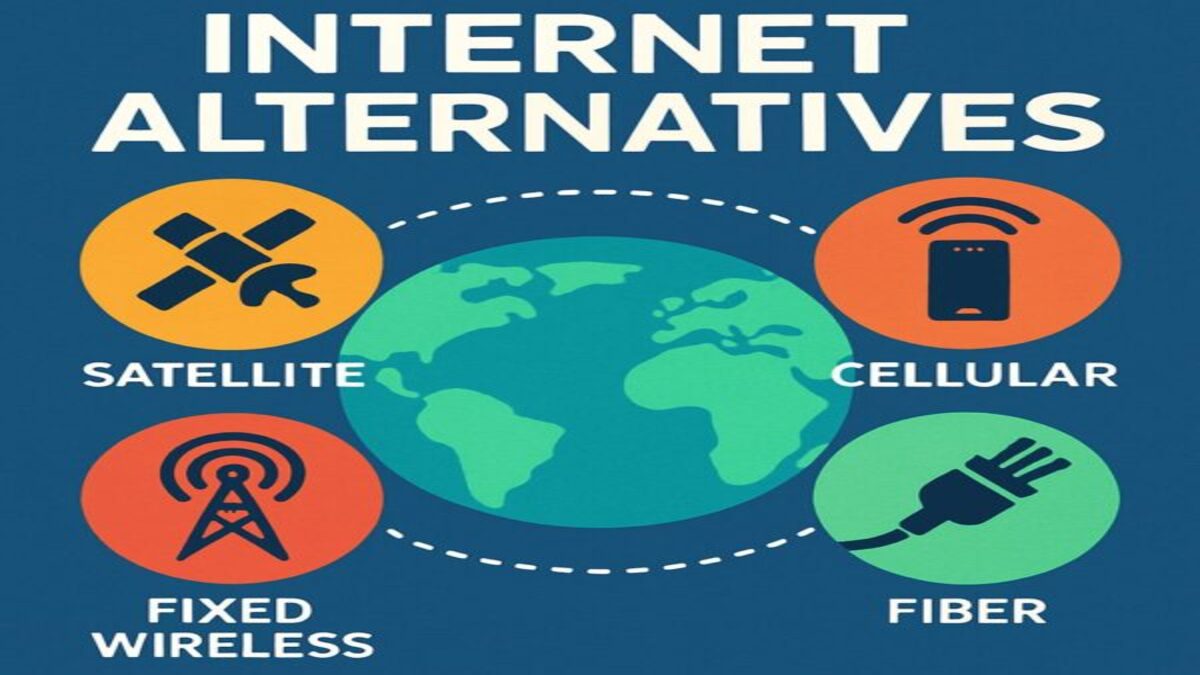
Your alternatives may include:
- Satellite internet
- Fiber internet
- Fixed wireless
- 5G or LTE home internet
- DSL
- Mobile broadband
- Regional or cooperative broadband
The right place to start is your exact service address.
Don’t assume that a provider serving your ZIP code necessarily serves your home, and don’t assume that cable being unavailable means every other high-speed option is unavailable too.
1. Satellite Internet
Satellite internet is one of the most important alternatives when cable and fiber networks don’t reach the property.
Instead of depending on a physical broadband line running down your road, satellite internet communicates with satellites in space.
That makes it particularly useful for:
- Rural homes
- Remote properties
- Farms and ranches
- Cabins
- Country homes
- Manufactured homes
- Properties outside cable and fiber networks
The major residential satellite options include Viasat, Starlink, and Hughesnet.
These providers use different network architectures and service structures, so they should be compared based on what is currently available at your address rather than treated as interchangeable.
Viasat Internet
Viasat can be a practical cable alternative for rural and hard-to-connect properties.
Its biggest strength is reach. Viasat does not need a cable or fiber provider to extend terrestrial broadband infrastructure all the way to the property.
Viasat currently advertises residential service speeds up to approximately 25–150 Mbps in select areas.
Speeds are advertised as “up to,” are not guaranteed, and vary based on location, available plan, congestion, network conditions, Wi-Fi performance, and other factors.
Viasat’s current residential service also includes unlimited data in different forms.
Viasat Essentials
Essentials is designed primarily for lighter internet users.
It includes 150 GB of High-Speed Data followed by unlimited Standard Data.
After the included High-Speed Data has been used, the internet connection continues.
Standard Data may receive lower network priority during congestion, which can result in slower performance.
Viasat Unleashed
Unleashed is designed for households with greater internet usage.
It includes unlimited High-Speed Data rather than a fixed monthly High-Speed Data allowance.
Viasat’s current Unleashed service also has no long-term contract.
Network-management policies still apply. Customers whose usage trends above typical residential usage may receive reduced priority during periods of network congestion.
Viasat Unleashed Max
Viasat’s newer residential lineup also includes Unleashed Max as a higher-tier option.
Unleashed Max includes unlimited High-Speed Data and adds higher network priority during busy periods.
EasyCare is also included with the current Max offering, and Viasat describes it as having no long-term contract.
Plan availability can vary by address, so always verify which current Viasat options are actually offered at your property.
Why Viasat Can Make Sense When Cable Isn’t Available
Viasat shouldn’t automatically be treated as an internet service of last resort.
It solves a different problem from cable.
Cable requires the provider’s physical network to extend close enough to your property. Viasat uses satellite technology, allowing it to reach many locations that wired broadband providers do not serve.
Current Viasat benefits can include:
- Broad rural and remote availability
- Unlimited-data residential options
- Unlimited High-Speed Data through Unleashed options
- No long-term contract on current Unleashed options
- Professional installation
- Built-in Wi-Fi equipment
- Multiple service levels for different household needs
Satellite internet still has tradeoffs, particularly higher latency on geostationary networks and potential congestion-related performance changes.
But those factors should be weighed against the alternatives actually available at your property.
Professional Viasat Installation
Viasat residential satellite internet is professionally installed.
A technician evaluates the property and determines an appropriate location for the satellite equipment.
The installation generally includes:
- Evaluating possible equipment locations
- Installing and aligning the outdoor satellite equipment
- Running the necessary cabling
- Connecting the Viasat modem or gateway
- Verifying the connection
Professional installation can be especially helpful at properties with trees, unusual roof configurations, outbuildings, or other installation challenges.
See What Happens During Viasat Installation? for more information.
What About Starlink?
Starlink is another satellite internet option worth comparing.
Unlike Viasat’s geostationary satellite architecture, Starlink uses a constellation of satellites in low Earth orbit.
Its lower orbital altitude generally gives Starlink a latency advantage.
That can be valuable for highly interactive applications such as certain online games, remote desktops, and other latency-sensitive services.
Starlink also requires an appropriate view of the sky, and trees or structures can interfere with service.
Instead of assuming Starlink is automatically better for every property, compare the current:
- Availability
- Monthly cost
- Equipment offer
- Installation requirements
- Expected speeds
- Latency
- Data policy
- Household usage
A rural household may reasonably prefer one satellite provider over another depending on its needs and property conditions.
What About Hughesnet?
Hughesnet is another established satellite provider serving rural and hard-to-connect properties.
Its plans and network have changed considerably over time, so older assumptions about Hughesnet maximum speeds or data policies should not be used to make a current decision.
Compare the current Hughesnet service offered at your address with Viasat and Starlink.
See our Viasat vs. Hughesnet guide for a closer comparison.
2. Fixed Wireless Internet
Fixed wireless uses a terrestrial wireless network to provide internet service to a property.
Many local and regional wireless internet providers use this technology to reach rural and semi-rural communities.
Fixed-wireless performance can vary based on:
- Provider technology
- Distance from network infrastructure
- Terrain
- Trees
- Buildings
- Network capacity
- Signal conditions
Some systems require relatively clear communication between provider equipment and the customer’s location, while other wireless technologies can tolerate certain obstructions.
When a strong fixed-wireless provider serves your property, it can be an excellent cable alternative.
3. 5G and LTE Home Internet
5G and LTE home internet use cellular-network infrastructure to provide residential broadband.
Major services include:
- T-Mobile Home Internet
- Verizon 5G Home Internet
- AT&T Internet Air
These services typically use a gateway that connects to the provider’s wireless network and creates Wi-Fi inside the home.
Setup can be relatively simple when self-installation is available.
The primary limitation is availability.
A strong cellular signal on your phone does not automatically mean home internet service is available at the address.
Providers can consider both signal coverage and network capacity when determining home internet eligibility.
See our 5G Home Internet guide for more information.
4. Fiber Internet
If cable isn’t available, fiber may still be worth checking.
Fiber uses fiber-optic infrastructure and can provide very high download and upload speeds with low latency.
Depending on the provider and plan, fiber can be particularly attractive for:
- Heavy streaming
- Remote work
- Large uploads
- Cloud backups
- Online gaming
- Households with many connected devices
The biggest limitation is infrastructure availability.
Fiber can run through one neighborhood or community without reaching another nearby property.
Rural fiber networks are also expanding in some areas through regional providers and electric cooperatives.
Check the actual service address before assuming fiber isn’t an option simply because cable isn’t available.
5. Mobile Hotspots
A mobile hotspot shares a cellular internet connection with other devices over Wi-Fi.
Hotspots can be useful for:
- Temporary internet access
- Travel
- Backup internet
- Seasonal properties
- Lighter internet use
Whether a hotspot works as primary home internet depends on signal strength, the carrier’s plan, hotspot data policies, network conditions, and household usage.
A hotspot should not automatically be dismissed, but households that stream heavily, work remotely, or connect many devices may be better served by a dedicated home internet service.
6. DSL Internet
DSL uses copper telephone infrastructure to provide internet service.
It remains available in some areas where newer broadband networks have not yet been built.
DSL performance can vary significantly based on:
- Distance from provider equipment
- Condition of the copper infrastructure
- The particular DSL technology
- Local network design
Some DSL connections can support everyday browsing, streaming, email, and lighter household use.
Others may provide considerably lower speeds.
You don’t necessarily need an active traditional voice subscription for every DSL service. Provider requirements vary.
Rather than automatically calling DSL a last resort, compare the actual service available at your address.
Don’t Confuse Cable Internet With Cable TV
If you’re trying to avoid cable because you don’t want a television package, there is an important distinction.
You generally don’t need cable TV to purchase cable internet.
Many cable providers sell standalone internet service.
So if cable infrastructure reaches your property but you simply don’t want television service, check whether an internet-only plan is available before ruling cable out.
If the physical cable network itself does not reach your property, then satellite, fixed wireless, cellular home internet, fiber, DSL, or local broadband become more relevant.
What Should You Compare Before Choosing an Internet Provider?
Once you know which services are available, compare more than the advertised download speed.
Availability
Can the service actually be ordered at your complete street address?
Download and Upload Performance
Look at the speeds associated with the actual plan offered at your location.
Latency
Latency can matter for online gaming, VPNs, remote desktops, video calls, and other interactive applications.
Data Policies
Understand whether the service includes unlimited data, High-Speed Data allowances, priority data, or network-management rules.
Contract Terms
Check whether a minimum service commitment applies and what happens if you cancel early.
Equipment
Find out what equipment is required, whether it is leased or purchased, and what happens to the equipment when service ends.
Installation
Determine whether the service is self-installed or professionally installed and whether non-standard installation work can involve additional charges.
Total Cost
Look beyond the promotional monthly rate.
Consider:
- Monthly service
- Post-promotion pricing
- Equipment
- Installation
- Taxes and applicable fees
- Optional services
Be Careful With Static Internet Price Comparisons
Internet prices and promotions change frequently.
A comparison that lists a provider at one specific monthly price can become outdated surprisingly quickly.
The same is true for equipment promotions, contract terms, discounts, and speed tiers.
For that reason, use current address-specific offers when comparing providers rather than relying on old nationwide pricing tables.
Use the FCC National Broadband Map
The FCC’s National Broadband Map is a useful place to research internet availability.
Enter your complete service address to see providers reporting service at that location.
The map can show information including:
- Reported internet providers
- Technology type
- Maximum advertised speeds
- Availability information
The availability information is reported by providers to the FCC, so the map should be treated as an excellent starting point rather than a guarantee that every listed service can immediately be ordered.
If information for your property appears incorrect, the FCC provides a process for challenging reported availability.
What if No Cable Provider Serves My Rural Property?
Satellite internet should be one of the first alternatives you investigate.
A rural property may be many miles from cable or fiber infrastructure.
Satellite technology doesn’t require those networks to extend all the way to your home.
Viasat can therefore be particularly relevant for:
- Rural homes
- Farms
- Ranches
- Cabins
- Manufactured homes
- Country properties
- Remote homes
Fixed wireless and cellular home internet should also be checked because those technologies may serve some rural locations.
The point is not to choose Viasat before checking anything else.
The point is to make sure Viasat is actually included in the comparison instead of assuming modern satellite internet is automatically inferior.
Can You Stream Without Cable Internet?
Yes.
Fiber, 5G home internet, fixed wireless, satellite internet, DSL, and other technologies can all support streaming when sufficient performance and data are available.
Viasat’s current Unleashed service is particularly relevant for frequent streaming households because it includes unlimited High-Speed Data.
Streaming performance also depends on:
- Actual connection speed
- Network congestion
- Wi-Fi performance
- Video resolution
- The number of simultaneous streams
- Other devices using the connection
Can You Work From Home Without Cable?
Yes.
Many fiber, fixed-wireless, 5G home internet, satellite, and DSL connections can support common remote-work activities.
These can include:
- Web applications
- Cloud software
- Document collaboration
- File transfers
- Video meetings
If your job requires specific VPNs, remote desktops, security platforms, or other latency-sensitive applications, verify those requirements before choosing a service.
Can You Get Internet Without a Phone Line?
Yes.
Satellite, fiber, cable, fixed wireless, and cellular home internet do not require you to maintain a traditional landline telephone subscription.
Some DSL services also offer internet without requiring traditional voice service, depending on the provider.
What if Trees or Terrain Make Wireless Internet Difficult?
Physical conditions around the property can affect several internet technologies.
Trees, hills, mountains, buildings, and valleys can influence terrestrial wireless signals.
Satellite equipment also requires an appropriate view of the sky.
Different technologies respond differently to the same property conditions.
For Viasat, a professional installer evaluates the property and determines whether a suitable satellite installation location exists.
Internet Availability Can Change Over Time
Broadband networks continue to expand.
A property without cable, fiber, or fixed wireless today may gain additional options in the future through:
- Private network expansion
- Regional internet providers
- Electric cooperatives
- Municipal broadband
- State broadband projects
- Federal broadband programs
That doesn’t mean a particular service will arrive at your property on a predictable timeline.
If you need better internet now, compare the options currently available and periodically recheck for new service later.
Which Cable Alternative Should You Choose?
There is no universal answer.
If fiber reaches the property, it may provide excellent performance.
If a strong 5G or fixed-wireless connection is available, it may fit your household well.
If you’re beyond terrestrial broadband networks, satellite internet becomes particularly important.
Viasat deserves serious consideration in that situation because it can reach many properties beyond cable and fiber infrastructure while offering current unlimited-data options and professional installation.
Starlink and Hughesnet provide additional satellite alternatives.
The best choice is the service that gives your household the strongest overall combination of:
- Availability
- Performance
- Data
- Latency
- Reliability
- Price
- Equipment
- Installation
- Service terms
If you’d like help exploring Viasat and other residential internet options for your property, call (844) WiFi-Man — (844) 943-4626 to speak with an Internet Specialist at High Speed Internet Now by Spacelink Installs.
Frequently Asked Questions
Can I Get High-Speed Internet Without Cable?
Yes.
Depending on your address, alternatives can include satellite internet, fiber, 5G or LTE home internet, fixed wireless, DSL, and local broadband providers.
Is Viasat a Good Alternative to Cable Internet?
Viasat can be a practical alternative for rural and hard-to-connect properties where cable infrastructure doesn’t reach.
Current residential service includes unlimited-data options and professional satellite installation.
Does Viasat Have Unlimited Data?
Yes.
Viasat’s current residential plans include unlimited data in different forms.
Essentials includes 150 GB of High-Speed Data followed by unlimited Standard Data, while Unleashed includes unlimited High-Speed Data.
Is Satellite Internet Only a Last Resort?
No.
Modern satellite internet should be evaluated as a legitimate broadband category, particularly for rural and remote properties beyond terrestrial wired networks.
Viasat, Starlink, and Hughesnet provide different satellite options with different characteristics.
Is Starlink Better Than Viasat?
Neither provider is automatically better for every property.
Starlink’s low-Earth-orbit architecture generally provides lower latency.
Viasat offers broad satellite reach, professional installation, current unlimited-data options, and multiple residential service levels.
Compare the actual current offers available at your address.
Can I Get 5G Home Internet Without Cable?
Yes, if a cellular home internet provider offers service at your address.
Availability depends on network coverage, capacity, signal conditions, and the provider’s eligibility requirements.
Can I Stream Without Cable?
Yes.
Several internet technologies can support streaming when sufficient speed, data, and reliability are available.
Can I Work From Home Without Cable?
Yes.
Fiber, fixed wireless, 5G home internet, satellite internet, and some DSL services can support many common remote-work activities.
Can I Get Internet Without a Phone Line?
Yes.
Satellite, fiber, cable internet, fixed wireless, and cellular home internet do not require a traditional landline telephone subscription.
How Do I Find Out Which Providers Serve My Address?
Check your complete street address directly with individual providers and use the FCC’s National Broadband Map as an additional research tool.
The FCC map displays provider-reported availability, technologies, and advertised speeds for individual locations.
How Can I Get Help Finding Internet if Cable Isn’t Available?
If you’d like help exploring Viasat and other residential internet options for your property, call (844) WiFi-Man — (844) 943-4626 to speak with an Internet Specialist at High Speed Internet Now by Spacelink Installs.